Southern Finance Association, Fall 2025
WALDORF ASTORIA- ORLANDO, FL Nov. 19 – 22, 2025
2025 Outstanding Paper Awards
Asset Pricing, sponsored by the American Association of Individual Investors (AAII):
Local Equity Bias and the Legalization of U.S. Sports Betting
Shaddy Douidar, Matthew Henriksson, Christos Pantzalis,and Jung Chul Park
We investigate local stock trading behavior around the staggered legalization of sports betting across 34 U.S. states and D.C. After betting is legalized, local equity bias exhibits a relative increase in states with more lottery stocks, fewer sportsbooks, and where gamblers are most successful. Results remain robust when matched with states where betting is illegal and when excluding states with extreme stock market participation. These findings imply that sports betting complements risky local equity investment preferences. Consistent with this view, we show that after sports betting becomes legal, retail investors increase their trading activity of local lottery stocks.
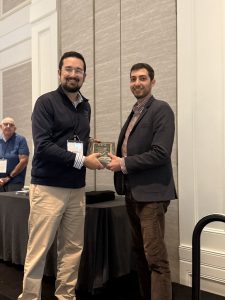 Shaddy Douidar (University of Nevada, Reno) accepts the award for Outstanding Asset Pricing Paper from SFA Vice President, John Sedunov.
Banking, sponsored by the Southern Finance Association:
Banking Local: Media Slant, Erosion of Trust, and Financial Decisions
Elizabeth Berger, Haaris Mateen, and Dario Romero
We study the effect of a change in media slant on banking decisions made by households. We use the staggered expansion of a local TV news station operator with a well documented slant in broadcasting that emphasizes a more negative view of national events. We find that depositors shift their deposits from national banks to local banks in areas that are exposed to the news media shock. Likewise, borrowers shift their borrowing activity. These effects are stronger among low-income and male borrowers. Banks are not engaging in credit rationing, expansions or contractions, or changes in loan and deposit rates to attract consumers. We provide evidence suggesting that an erosion in trust is the mechanism driving these results. In sum, media slant alters household financial decision making and these decisions have negative welfare consequences.
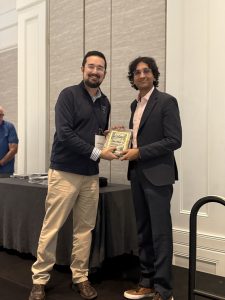 Haaris Mateen (University of Houston) accepts the award for Outstanding Banking Paper from SFA Vice President, John Sedunov.
Corporate Finance, sponsored by the Southern Finance Association:
When Speaking Freely Pays: Anti-SLAPP Laws and Firms’ Cost of Equity
Scott Guernsey, Matthew Serfling, and Cheng Yan
A fundamental question in corporate finance is whether a firm’s cost of equity (COE) is influenced more by the amount of information disclosed or by the direction and tone of that information. While greater transparency can reduce information asymmetry and lower financing costs, negative disclosures may increase perceived risk and, consequently, firms’ COE. We examine this trade-off using the adoption of U.S. state anti-SLAPP laws, which provide speech protections to corporate critics, thereby promoting the freer flow of information and negative disclosures. Employing an imputation-based difference-indifferences approach, we find that anti-SLAPP laws reduce firms’ COE, especially for those in opaque information environments or with better-informed employees. Further analysis suggests that this effect operates through declines in information asymmetry, return volatility, and systematic and stock price crash risk. Our findings highlight how legal institutions that encourage free speech can lower financing costs by enhancing transparency and reducing uncertainty in capital markets.
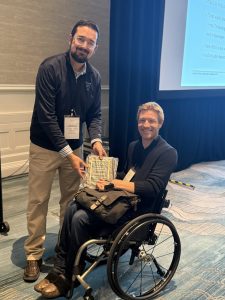 Matthew Serfling (University of Tennessee) accepts the award for Outstanding Corporate Finance Paper from SFA Vice President, John Sedunov.
ESG, sponsored by Wharton Research Data Services (WRDS):
Greenness Demand for US Corporate Bonds
Rainer Jankowitsch, Alexander Pasler, Patrick Weiss, and Josef Zechner
We characterize the demand for green securities based on institutional holdings of US corporate bonds. The generally positive demand for greenness shows significant time variation, with the highest average levels around the Paris Agreement in 2016 and a sharp decline during the Trump administration. The demand and its variation following exogenous events significantly affect prices and investors’ wealth. We also document real effects of investors’ greenness preferences at the corporate level. In particular, we find an association between increases in greenness demand and subsequent enhancement of firms’ environmental performance, as well as with more frequent bond issues and larger face values chosen by greener firms.
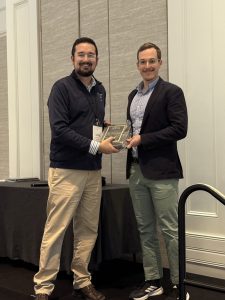 Alexander Pasler (Vienna University of Economics and Business) accepts the award for Outstanding ESG Paper from SFA Vice President, John Sedunov.
FinTech, sponsored by the University of South Florida:
Crypto Tax Evasion
Tom Meling, Magne Mogstad, and Arnstein Vestre
We quantify the extent of crypto tax noncompliance and evasion, and assess the efficacy of alternative tax enforcement interventions. The context of the study is Norway. This context allows us to address key measurement challenges by combining de-anonymized crypto trading data with individual tax returns, survey data, and information from tax enforcement interventions. We find that crypto tax noncompliance is pervasive, even among investors trading on exchanges that share identifiable trading data with tax authorities. However, since most crypto investors owe little in crypto-related taxes, enforcement strategies need to be well-targeted or cheap for benefits to outweigh costs.
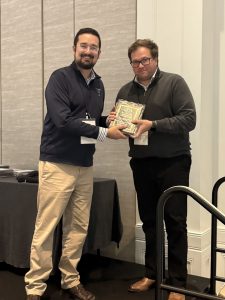 Tom Meling (The Ohio State University) accepts the award for Outstanding FinTech Paper from SFA Vice President, John Sedunov.
International Finance, sponsored by the Southern Finance Association:
China’s WTO Entry and Local U.S. Banks
Samar Ashour, Thomas Chemmanur, Xi Li, and Jiajie Xu
We analyze how the product market competition shock due to China’s WTO entry affects the US banks heterogeneously. Using a difference-in-differences empirical strategy, we document that in regions with greater exposure to the shock, loan quality deteriorates and bank profitability declines more severely, coupled with slower loan growth and higher loan interest rates after the shock. Further, small banks lose market share and banking market concentration increases more in these regions.
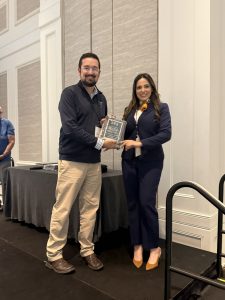 Samar Ashour (University of Alabama at Birmingham) accepts the award for Outstanding International Finance Paper from SFA Vice President, John Sedunov.
Special Topics, sponsored by the Southern Finance Association:
Invest Like for Your Kids: Performance and Implications of Children’s Investment Accounts on Portfolios in Adulthood
Denis Davydov and Jarkko Peltomäki
We investigate the performance of children’s investment accounts and their implications on portfolios in adulthood. We find that children’s accounts, often resembling passive investment strategies, yield annual returns three times higher with lower volatility compared to adults’ accounts. Risk-taking behavior does not significantly differ for kids of different genders during early childhood. Furthermore, young adults whose investment accounts were initiated during childhood demonstrate superior performance and a narrowed gap in risk-taking between men and women compared to their peers. These findings emphasize the importance of passive investment strategies and highlight the influential role parental interventions play in shaping investment attitudes.
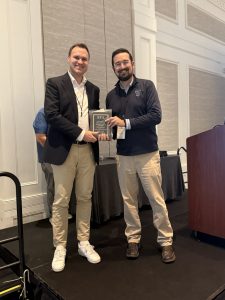 Denis Davydov (Hanken School of Economics) accepts the award for Outstanding Special Topics Paper from SFA Vice President, John Sedunov.
Doctoral Student Papers, sponsored by the Southern Finance Association:
(Don’t) Go Woke, Go Broke? An Analysis of Public Pension Plan Investment Restrictions
Madison Borrelli
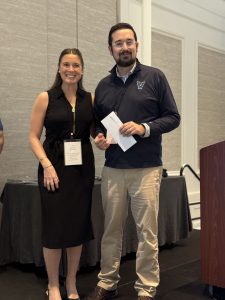 Madison Borrelli (University of Central Florida) accepts the award for Outstanding Doctoral Student Paper from SFA Vice President, John Sedunov.
Rational Credit Cycles
Bosang Kim
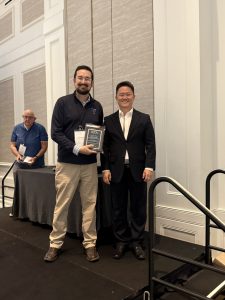 Bosang Kim (University of Alabama) accepts the award for Outstanding Doctoral Student Paper from SFA Vice President, John Sedunov.
Efficient or Not? Price Measures in Market Microstructure
Niklas Trimpe and Tino Cestonaro
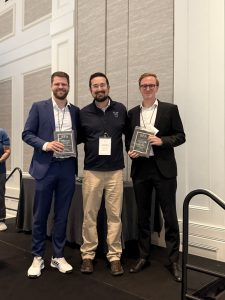 Niklas Trimpe and Tino Cestonaro (Goethe University Frankfurt) accept the award for Outstanding Doctoral Student Paper from SFA Vice President, John Sedunov.
Southern Finance Association, Fall 2024
PGA NATIONAL RESORT – PALM BEACH GARDENS, FL Nov. 20 – 23, 2024
2024 Outstanding Paper Awards
Corporate Finance, sponsored by the Southern Finance Association:
Are Insiders’ Forecasts Reliable to Outsiders? Evidence from Analysts’ Reaction to Merger Synergy Projections
Nabil El Meslmani, Ahmad Ismail, Mohammed Uddin
We examine whether merger-specific information is valuable to sell-side analysts and to stock markets. Analysts revise their earnings forecasts upward for acquirers that disclose larger projected synergies, more specifically, cost savings but not revenue synergies. We show that analysts can see through heterogeneity stemming from CEO personal traits and can process complex information and adjust their forecasts around strategic corporate events. Interestingly, analysts rely more on synergy projections disclosed by non-overconfident CEOs, well governed firms, or when analysts’ forecast quality is not reliable. Analysts’ forecast accuracy improves for firms that disclose larger synergies. Furthermore, investing in a portfolio with High (Low) synergy forecasts and High (Low) analyst forecast revisions generates the highest (lowest) risk adjusted excess returns, suggesting that both management synergy forecasts and analyst forecasts are informative to the stock markets.

Nabil El Meslmani (Saint Mary’s University) accepts the award for Outstanding Empirical Finance Paper from SFA executive director, Ronnie Clayton.
Empirical Finance, sponsored by Wharton Research Data Services (WRDS):
Do Investors Have Data Blind Spots? The Role of Data Vendors in Capital Markets
Sara Easterwood
Financial data vendors collect, aggregate, and process data on clients’ behalf. I show that data vendors’ coverage decisions affect institutional investor demand. I focus on Standard & Poor’s (‘S&P’) Compustat database as an empirical setting. Compustat provides subscribers with decades of 10-K and 10-Q data; however, it does not cover every public firm in every period. I show that institutional investment in firms with no Compustat coverage is over 36% below its unconditional mean, even controlling for other firm characteristics. A novel, quasi-natural experiment establishes a plausibly causal connection: a technology shock at S&P in the 1990s causes a discrete reduction in missing data. This change in data coverage is followed by a significant increase in institutional investment for treated firms relative to control firms. I then show that missing Compustat data is associated with lower informational efficiency of equity prices. I conclude that data vendors’ actions can exert a material influence on capital markets because they affect firms’ access to institutional capital.
 Sara Easterwood (Virginia Tech) accepts the award for Outstanding Empirical Finance Paper from SFA executive director, Ronnie Clayton.
Financial Institutions, sponsored by the Southern Finance Association:
What Did Policy Interventions Fix in the Municipal Bond Market – Liquidity or Credit?
Blake Marsh, Huixin Bi
We examine how policy interventions during the COVID pandemic impacted municipal bond market pricing. Focusing on narrow trading windows, we fi nd that announcements of fiscal and direct monetary policy interventions reduced liquidity risk concerns but did not immediately ease credit concerns. Using rolling-window regressions, we find that policy interventions eased credit concerns for short-term bonds over time, while longer-term bond spreads show increased credit risks. The credit risk shift from short- to long-term bonds reflects policy designs that benefitted short-term bonds more, as well as changing investor expectations on state and local government budgets due to the pandemic’s persistence.
 Blake Marsh (Federal Reserve Bank of Kansas City) accepts the award for Outstanding Financial Institutions Paper from SFA executive director, Ronnie Clayton.
FinTech, sponsored by the University of South Florida:
AI-Powered Analysts
Michael Kimbrough, Leonard Yang Liu, Musa Subasi
This study explores the impact of brokerage houses’ investments in artificial intelligence (AI) and machine learning (ML) on their analysts’ information production. Understanding the determinants of analysts’ information production is crucial, given its significant influence on stock prices and capital allocation decisions. Utilizing a novel AI-investment measure derived from job posting data, we identify a positive correlation between brokers’ prior AI investments and the enhanced accuracy of their analysts’ EPS forecasts. Consistent with AI’s role in diminishing information integration costs, our findings indicate that increased investments in AI and ML by brokers are associated with a lower tendency for analysts to make heuristic decisions. This includes aligning more closely with consensus forecasts and issuing rounded forecasts. Further cross-sectional analysis suggests a more pronounced AI benefit for analysts with less firm-specific experience, highlighting AI’s potential in lowering in-formation acquisition costs. Intriguingly, we observe that the stock market does not fully recognize or appreciate these effects, undervaluing the forecast revisions made by AI-powered analysts. Overall, our evidence points to the advantageous impact of AI and ML technologies on the information pro-duction capabilities of financial analysts.
 Leonard Yang Liu (University of Maryland) accepts the award for Outstanding FinTech Paper from SFA executive director, Ronnie Clayton.
International Finance, sponsored by the Southern Finance Association:
Production Outsourcing and Innovation: Evidence from China’s Pharmaceutical Industry
Shi Gu
I examine how removing barriers in production outsourcing affects firms’ innovation activities. I exploit a reform in China’s pharmaceutical industry that permits the outsourcing of drug production. Using a triple-difference identification strategy, I find that drug innovators without production facilities engage in more drug development (clinical trials) after the policy. Furthermore, for those firms constrained by limited financial resources, the increase in drug development comes at the expense of curtailing drug research (patent applications). On the extensive margin, the reform encourages the entry of new drug developers, but does not lead to more entry of pure drug researchers into the market. Overall, these results point to the pivotal role of production outsourcing in fostering entrepreneurship and innovation.
 Shi Gu (Northwestern University) accepts the award for Outstanding International Finance Paper from SFA executive director, Ronnie Clayton.
Investments, sponsored by the American Association of Individual Investors (AAII):
MiFID II Research Unbundling: Cross-border Impact on Asset Managers
Richard Evans, Juan Pedro, Rafael Zambrana
MiFID II requires EU investment advisors to “unbundle” research costs from execution fees. We find evidence that this unbundling for EU Funds is accompanied by an increase in bundled commissions generated by their US counterparts. Specifically, for EU funds with US twins (a US-based fund with the same management team and investment style), the US twin exhibits higher bundled commissions (also known as “soft dollars”) and worse net performance than other US funds following MiFID II mandated unbundling. Correspondingly, EU twin funds appear to profit from this cross-subsidization, outperforming similar US twins. Our findings suggest that agency costs are not mitigated but merely shifted from a more regulated market to a less regulated one. We conclude that in global financial markets, only internationally coordinated regulatory actions are effective.
 Richard Evans (UVA- Darden) accepts the award for Outstanding Investments Paper from SFA executive director, Ronnie Clayton.
Sustainability, sponsored by the Southern Finance Association:
She Means Business: From Courtroom Biases to Post-Bankruptcy Triumphs
Hadiye Aslan
The widespread adoption of smartphones enhances the importance of mobile apps in firms’ operations. This paper proposes a timely and easily accessible measure of mobile app usage using more than 54 million app reviews from Google Play and examines the implications of app usage to firm value. I find that a hedged portfolio that long (short) stocks with high (low) abnormal review volume from 2013 to 2022 yields an alpha ranging from 55.4 to 61.9 basis points per month under various risk models. App usage also positively correlates with contemporaneous profitability and revenue surprises. These results suggest that app reviews contain valuable information about firm fundamentals that is not fully recognized by the stock market.
 Hadiye Aslan (Georgia State University) accepts the award for Outstanding Sustainability Paper from SFA executive director, Ronnie Clayton.
Doctoral Student Papers, sponsored by the Southern Finance Association:
The Impact of Mobile App Usage on Firm Value
Zheng Liu
We hypothesize that gender plays an important role in determining outcomes in business bankruptcy outcomes. We rely on the random assignment of cases among judges within a given jurisdiction to draw causal inference from our empirical analysis. Using a comprehensive dataset of individual sole proprietor and single-owner LLC bankruptcy petitions, we find that female business owners are 26 percent more likely to have their cases dismissed or converted to Chapter 7 compared to their male counterparts. The results are stronger if the presiding judge is a male and have less courtroom or industry-specific experience. We find that post-reorganization businesses owned by women are less likely to fail and show stronger sales growth compared to those owned by men. Finally, the occurrence of less favorable rulings towards women in bankruptcy court cases results in a reduction of female business start-ups by nine percent when compared to their male counterparts, with stronger effects in districts characterized by a higher degree of egalitarian values and where access to banking finance is more stringent.
 Zheng Liu (University of Texas at Dallas) accepts the award for Outstanding Doctoral Student Paper from SFA executive director, Ronnie Clayton.
Regulating Inventors
Torin McFarland
I study how regulatory burden disrupts the careers of productive inventors. Using structural topic modeling and the text of compliance regulations, I develop a time-varying inventor-specific measure of regulatory burden. Inventors facing high burden exhibit decreased productivity and lower quality innovations. These results are concentrated in Star Inventors. A 1 standard deviation increase in time spent on compliance decreases Star patenting by 13.9% (14,900 patents annually in aggregate) and scaled citations by 2.8%. These effects are identified within inventor over time, net of employer-city trends, ruling out alternative explanations like time-varying employer innovation strategy or location-specific innovation factors. In terms of labor market outcomes, I find evidence consistent with a disutility channel: after experiencing increases in burden, inventors are more likely to switch jobs, and to seek positions at larger employers. Overall, the findings document the innovation consequences of regulatory burden, influencing both the quantity and quality of patented inventions, and the mobility of inventors.
 Torin McFarland (Drexel University) accepts the award for Outstanding Doctoral Student Paper from SFA executive director, Ronnie Clayton.